
The Myth and The Method of Mastery
Let’s be real for a moment. We’ve all been there. That dusty guitar in the corner of the room, a silent monument to a fleeting passion. The language-learning app with a 30-day streak that ended six months ago, now buried on the third page of your phone. The half-finished coding project saved deep in a forgotten folder, a digital ghost of a brilliant idea. We start with a blazing fire of enthusiasm, convinced this time will be different. But then, progress stalls. The initial fun evaporates, replaced by a steep, unyielding wall of frustration. And so, we quit, quietly telling ourselves a story: “I’m just not talented at this.”
Then we look at the masters, and the story seems to confirm itself. The chess grandmaster who sees the board 20 moves ahead, navigating possibilities with an intuition that seems otherworldly. The virtuoso musician whose fingers don’t just play notes but express the deepest human emotions. The polyglot who switches between languages with the effortless grace of a bird taking flight. Their ability seems magical, almost superhuman. It’s tempting to believe they were simply born with a gift, a special “talent gene” the rest of us are missing.
What if we told you that’s a myth? Seriously though, the idea of innate, untouchable talent is one of the most pervasive and damaging myths in personal development. It’s a convenient excuse that lets us off the hook when things get tough. Here at The Intellect Hive, we’ve synthesized decades of scientific research, and the conclusion is clear: mastery isn’t magic; it’s a method. It’s not a gift; it’s a process. It’s a science of skill acquisition available to anyone with the right framework. This is fantastic news because it means you have the power to master anything you set your mind to. Your potential is not predetermined at birth.
In this definitive guide, we will dismantle the myth of talent and give you the keys to the kingdom. We’re providing a clear, actionable, and science-backed 5-step framework that moves far beyond vague advice like “just practice more.” This is the blueprint that separates the dabblers from the masters, the amateurs from the pros. This is the operating system for excellence. This is how you learn to master anything.
Preparing Your Mind for Mastery
Before we even touch the “how” of skill acquisition, we have to rebuild the “what”—your mindset. You can have the best car in the world, equipped with a state-of-the-art engine and aerodynamic design, but without the right fuel, you’re going nowhere. Your mindset is the high-octane fuel for the long and demanding journey to mastery. Getting this part right is non-negotiable, and it sets the stage for everything that follows. The journey to master anything begins not in your hands or your feet, but between your ears.
This post contains affiliate links. That means if you click a product link and make a purchase, we may earn a small commission—at no extra cost to you. As an Amazon Associate, we earn from qualifying purchases. It’s one of the ways we keep this website running and continue bringing you helpful content. So, thank you—seriously, your support means the world to us!
Step 1: Cultivate a Growth Mindset
The first, and arguably most critical, step on the path to master anything is adopting a Growth Mindset. This concept comes from Dr. Carol S. Dweck’s groundbreaking research, detailed in her bestselling book, Mindset. It fundamentally alters how you view challenges, effort, and failure, transforming them from threats into opportunities.
Dweck identified two core mindsets that shape our reality:
- Fixed Mindset: This is the belief that your abilities, intelligence, and talents are fixed traits. You have a certain amount, and that’s it. In this view, every challenge becomes a final exam on your innate ability. If you fail, it’s a verdict: you aren’t smart or talented enough. People with a fixed mindset often avoid challenges (to avoid the risk of failure), give up easily when they face obstacles, and see effort as a sign of weakness. Why try if you don’t have the “gift”? It’s a self-fulfilling prophecy of stagnation.
- Growth Mindset: This is the belief that your abilities can be developed and cultivated through dedication, smart strategies, and hard work. This mindset understands that the brain is not a static organ; it is remarkably plastic. New connections can be formed, and old ones can be strengthened. This concept of neuroplasticity is the biological basis for the growth mindset. With this belief, challenges are not threats; they are exciting opportunities to grow. Failure isn’t a verdict on your ability; it’s a data point providing valuable information for improvement. Effort isn’t a sign of weakness; it’s the very path that forges mastery.
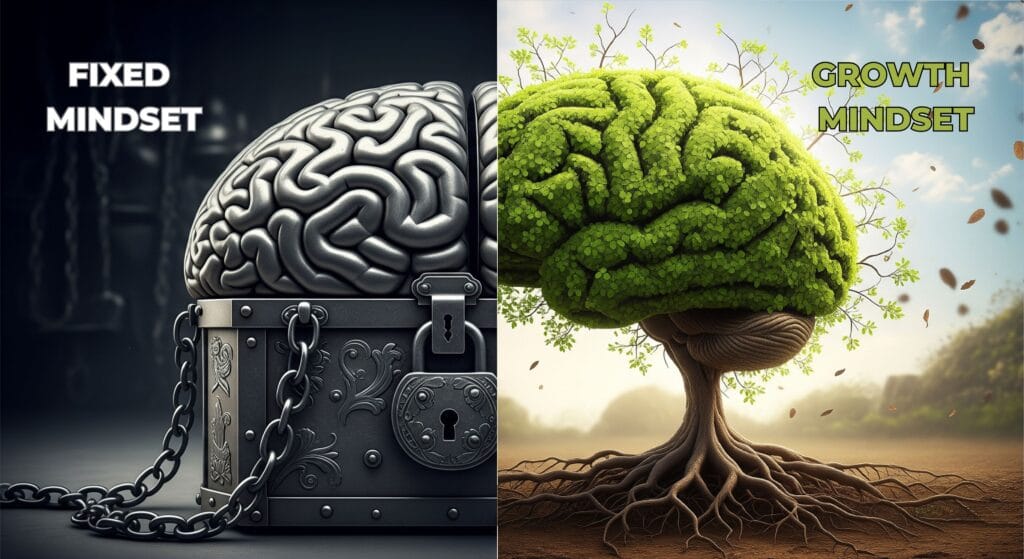
The Neuroscience of “Not Yet”
When you embrace a growth mindset, you’re not just engaging in positive thinking; you’re actively changing the physical structure of your brain. Every time you push yourself to the edge of your abilities and make a mistake, you fire a specific neural circuit. When you recognize that mistake and make a correction, you fire it again, but correctly this time. This process of struggle, error, and correction does something remarkable: it triggers a process called myelination.
Myelin is a fatty substance that acts as an insulator around your neural pathways. Think of it as upgrading a slow, choppy country lane into a high-speed fiber-optic cable. The more you struggle and correct on a specific skill, the more myelin your brain wraps around that circuit. This increases the speed and accuracy of the nerve signals by up to 100 times. This is why “practice makes permanent,” not just perfect. A growth mindset encourages you to engage in the very struggle that builds these superhighways in your brain. When you say, “I can’t do this yet,” you are giving your brain the permission and the stimulus it needs to physically build the capacity to do it. A fixed mindset, by avoiding struggle, literally keeps its neural pathways in a primitive, uninsulated state.
How to Actively Cultivate a Growth Mindset
Adopting a growth mindset isn’t like flipping a switch; it’s like tending a garden. It requires consistent effort and awareness. Here are tangible ways to nurture it:
- Change Your Self-Talk: Pay attention to the voice in your head. When you catch yourself saying “I can’t do this,” consciously add the word “yet.” “I can’t solve this coding problem” becomes “I can’t solve this coding problem yet.” This simple addition transforms a judgment into a journey.
- View Challenges as Opportunities: Instead of shying away from difficult tasks, seek them out. When your manager offers you a project that feels slightly beyond your current skills, your growth mindset response should be excitement, not fear. This is your chance to expand your capabilities.
- Focus on Process, Not Just Results: Instead of obsessing over whether you won or lost, focus on whether you put in your best, most focused effort. After a practice session, don’t just ask, “Did I succeed?” Ask, “Did I follow my plan? Did I push myself? What did I learn?”
- Reframe Feedback and Criticism: A fixed mindset dreads criticism. A growth mindset craves it. See feedback not as a personal attack, but as a gift of valuable data that can accelerate your learning. When someone points out a flaw, your first thought should be “Thank you,” not “How dare you.”
Here’s a quick comparison of how the two mindsets react in common scenarios:
| Situation | Fixed Mindset Response | Growth Mindset Response |
| Facing a Difficult Task | “This is too hard. I’ll probably fail, so why bother trying?” | “This is a challenge! It will be tough, but I’ll learn so much.” |
| Receiving Criticism | “They think I’m incompetent. I feel attacked and defensive.” | “This feedback is useful. It’s showing me exactly where I need to improve.” |
| Making a Mistake | “I’m such an idiot. I knew I couldn’t do this.” | “Okay, that approach didn’t work. What’s another way I can tackle this?” |
| Seeing a Peer Succeed | “I’m so jealous. They’re just naturally better than me.” | “That’s so inspiring! I should ask them how they did it and what I can learn.” |
Before you proceed, take a moment to internalize this. Your potential is not a fixed quantity. It is a dynamic capacity that you can expand through focused effort. That belief is the bedrock of all elite skill acquisition.
The Framework: A 5-Step Process for Acquiring Any Skill
Alright, with our growth mindset securely in place, it’s time to get our hands dirty. We’re moving from the “why” to the “how.” This is the practical, step-by-step blueprint for elite skill acquisition. Think of it as your personal operating system for learning. Follow these steps, and you will have a structured, repeatable process to master anything, whether it’s learning a new language, becoming a coding wizard, or perfecting your golf swing.
Step 2: Deconstruct the Skill
No one learns to “play chess.” That’s not a thing. The thought alone is completely overwhelming. Instead, you learn fundamental components: how the pieces move, basic opening principles, middle-game tactics like pins and forks, and end-game strategies like creating a passed pawn. The path to mastery begins with breaking a complex, intimidating skill down into its smallest, most fundamental components. We call these “micro-skills.”
Deconstruction serves two critical purposes:
- It makes the skill manageable: Instead of facing a giant, monolithic mountain called “Public Speaking,” you now have a series of small, climbable hills: Vocal Tonality, Body Language, Speech Writing, Audience Engagement, and Handling Q&A. This transforms overwhelm into a clear, actionable checklist.
- It allows for targeted practice and optimization: You can identify your weakest link and focus your energy there. This is where the Pareto Principle (the 80/20 rule) comes into play. This is a critical insight on the path to master anything: by deconstructing the skill, you can identify the 20% of micro-skills that will deliver 80% of the results. For many new guitar players, for instance, the 20% is clean chord changes. Nailing that one micro-skill unlocks hundreds of songs.

Two Methods for Effective Deconstruction
Simply listing out components is a start, but a more strategic approach can dramatically accelerate progress. Consider two powerful methods:
- Tracing (Working Backwards from Masters): This involves finding examples of expert-level work and deconstructing them to understand their composition. Benjamin Franklin famously used this method to teach himself to write. He would read articles from great writers, jot down notes on their arguments, and then try to recreate the article in his own words. Finally, he would compare his version to the original, identifying the gaps in his logic and prose.
- In Practice: If you want to learn to code a web app, find a well-structured open-source project on GitHub and meticulously “trace” its code, figuring out what each line does. If you want to learn to cook a French dish, find a recipe from a master chef like Julia Child and follow it to the letter, paying attention to why each step is performed in that specific order. Tracing gives you a proven roadmap of what “good” looks like.
- Scaffolding (Building Sequentially): This is a more forward-looking approach where you identify the absolute prerequisite micro-skills and master them in a logical order. You cannot learn algebra without first understanding arithmetic. You cannot write a sentence without first knowing the alphabet. Scaffolding is the process of building a stable foundation before adding the next layer.
- In Practice: For learning a language, the scaffold might be: 1. Master the core phonetic sounds. 2. Learn the 100 most common words. 3. Understand the most basic sentence structure (Subject-Verb-Object). 4. Learn the present tense of the most common verbs. Each step builds directly and logically on the last. This prevents you from trying to tackle advanced concepts before you’ve mastered the fundamentals, which is a primary source of frustration and quitting.
Before you start any new learning journey, take the time to deconstruct using these methods. Grab a notebook or a whiteboard. Write the main skill at the top and then brainstorm every single sub-skill you can think of. This map will be your guide to master anything.
Step 3: Engage in Deliberate Practice
This is the core engine of skill acquisition. If you only take one thing away from this entire guide, let it be this. Not all practice is created equal. The concept of Deliberate Practice, pioneered by researcher Anders Ericsson, is the true differentiator between amateurs and experts and is explored fully in his book, Peak: Secrets from the New Science of Expertise.
So, what is it? Let’s first define what it isn’t. It isn’t “naive practice.” Naive practice is just mindlessly going through the motions. It’s hitting 100 golf balls without thinking, playing the same song on the piano over and over (mistakes and all), or jogging the same route at the same pace every day. Naive practice gets you to a “good enough” level and then you stop improving. You’re putting in hours, but you’re not getting better.
Deliberate Practice, on the other hand, is purposeful, systematic, and requires intense focus.
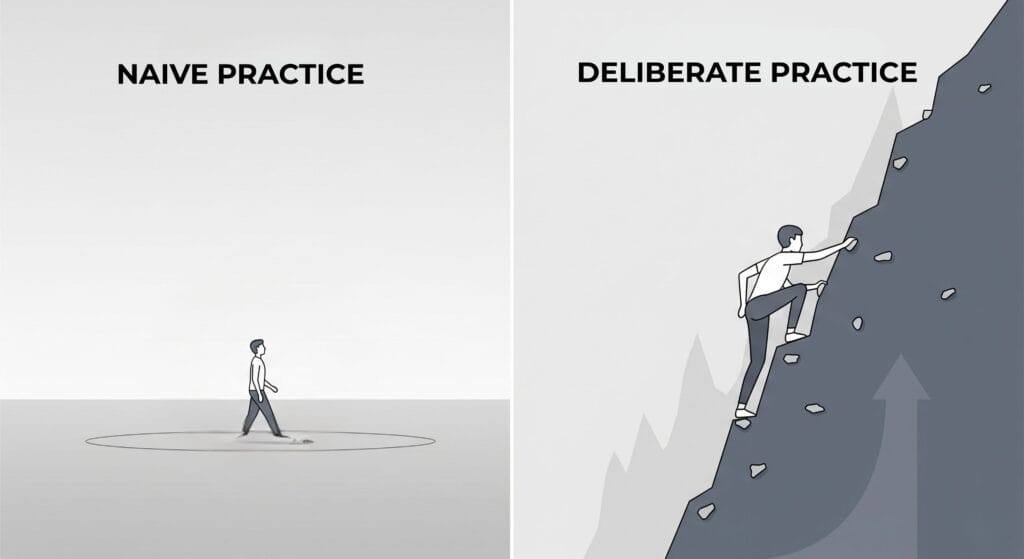
Evidence suggests its key elements are:
- Highly Focused Attention: You are 100% engaged in the task. No phone, no TV, no distractions. Your entire mental capacity is directed at the specific micro-skill you are practicing.
- Pushing Beyond Your Comfort Zone: This is crucial. Deliberate practice happens at the edge of your current abilities. It should feel difficult. This is the “Goldilocks Zone” of learning: not so easy that you’re bored, not so hard that you’re anxious and overwhelmed, but just right to stretch you. If you’re not making mistakes, you’re not learning.
- Specific, Well-Defined Goals: You never just “practice.” You have a clear objective for the session. For example, “Today, I’m not just ‘playing guitar.’ My goal for the next 20 minutes is to transition cleanly between the G chord and the C chord at 60 beats per minute without any fret buzz.”
- Immediate Feedback: You must know instantly whether you did it right or wrong. This allows for rapid course correction.
Common Traps of Practice and How to Avoid Them
Even with the best intentions, it’s easy to fall into habits that feel like practice but yield minimal results. Be vigilant against these common traps:
- The Entertainment Trap: This is when you mistake passive consumption for active practice. Watching hours of YouTube tutorials on coding, reading books about chess strategy, or watching masterclasses on playing the violin feels productive, but it is not a substitute for writing code, playing games, or practicing scales.
- The Fix: Use a 5:1 ratio. For every one hour of instructional content you consume, spend at least five hours actively practicing the concepts you learned.
- The Repetition Trap: This is mindlessly repeating what you already do well. It’s comfortable and feels good, but it produces zero growth. It’s playing the one song you’ve mastered on the piano over and over instead of tackling the difficult new piece.
- The Fix: Start every practice session by asking, “What is the single most important weakness I need to work on right now?” and devote the majority of your time to that, even if it’s frustrating.
- The Burnout Trap: Deliberate practice is incredibly taxing on your brain. Trying to do it for hours on end is counterproductive. Your focus will wane, your technique will suffer, and you’ll build bad habits.
- The Fix: Practice in short, focused bursts. The Pomodoro Technique is perfect for this: 25 minutes of intense, focused practice on a single micro-skill, followed by a 5-minute break. After four cycles, take a longer 15-30 minute break. This respects your brain’s limits on intense concentration and keeps the quality of practice high.
The famous 10,000-hour rule? It’s meaningless if those hours are spent in these traps. It’s the quality of the hours, not the quantity, that forges mastery. Your goal is to make every hour count.
To truly understand the power of this concept, there’s no better source than the researcher who pioneered the work. In this interview, Dr. Anders Ericsson, the “father of deliberate practice,” explains the core principles of his research and debunks the myth of innate talent.
Step 4: Create Rapid Feedback Loops
Practice without feedback is like trying to navigate a maze with a blindfold on. You might be moving, but you have no idea if you’re getting closer to the exit or just bumping into the same wall over and over. A feedback loop is a system that tells you how you’re performing in real-time, allowing you to make immediate corrections. The shorter the time between your action and the feedback, the faster you learn. To master anything, you must become an obsessive seeker of high-quality feedback.
Sources of feedback can be broken down into a few categories:
- Coaches and Mentors: This is the gold standard. A great coach provides expert, external eyes on your performance. They see your mistakes before you do, understand why you’re making them, and provide specific, tailored advice to correct them. Their experience allows you to sidestep common pitfalls and years of trial and error. The process of finding a great mentor or coach is one of the single best investments you can make on your path to mastery.
- Self-Correction (Recording): This is the next best thing and is accessible to everyone. Record yourself. Not even kidding. It can be cringe-inducing at first, but it is brutally honest and effective. If you’re learning public speaking, record a video and watch for filler words (“um,” “ah”) and nervous tics. If you’re learning an instrument, record the audio to check your timing and tone. When you review, have a checklist of things you’re looking for based on the micro-skill you’re practicing. You will immediately see (or hear) the gap between what you thought you were doing and what you were actually doing.
- Software and Tools: We live in a golden age of feedback tools. Language apps give you instant pronunciation scores. Chess programs like a good chess engine analyze your every move and show you better alternatives. Fitness apps with a quality heart rate monitor track your performance metrics down to the second. Leverage technology to build your feedback loops and get objective data on your performance.
- Peer Feedback: Find a small group of people who are also serious about learning the same skill. Share your work with each other. A peer may not be an expert, but they can still spot things you miss and offer a fresh perspective. The key is to establish ground rules for giving and receiving feedback constructively.
- Performance Metrics: The results themselves can be a form of feedback. Did your code compile and run, or did it throw an error? Did the basketball go in the hoop? Did the soufflé rise? While this feedback is less nuanced (it tells you what happened but not why), it’s still a clear indicator of success or failure that can guide your next attempt.
The Hierarchy of Feedback: From Data to Wisdom
Not all feedback is created equal, and understanding the different levels is a secret weapon to master anything faster..
- Level 1: Data (Binary Feedback): This is the simplest form. Did it work or not? The code compiled or it failed. The ball went in the hoop or it missed. This is useful but provides no information about why.
- Level 2: Information (Corrective Feedback): This tells you what was wrong. A spell checker highlighting a typo. A coach saying, “You played a wrong note in that bar.” This is better, as it pinpoints the specific error.
- Level 3: Knowledge (Explanatory Feedback): This is where real learning begins. It tells you why something was wrong. “The reason you played a wrong note is because your finger positioning on the previous chord made the transition awkward and slow.” This feedback addresses the root cause.
- Level 4: Wisdom (Principled Feedback): This is the highest level, often delivered by a great mentor. It connects the specific error to a broader principle that you can apply in all future situations. “A more relaxed wrist posture, in general, will not only fix that specific chord transition but will improve your speed and accuracy across the entire fretboard.”
When seeking feedback, always try to push up this hierarchy. If your software gives you Level 1 feedback (an error), use your own analysis to get to Level 2 (where is the error?). If a peer gives you Level 2 feedback, ask them “Why do you think that happened?” to get to Level 3. A great coach is someone who consistently operates at Levels 3 and 4.
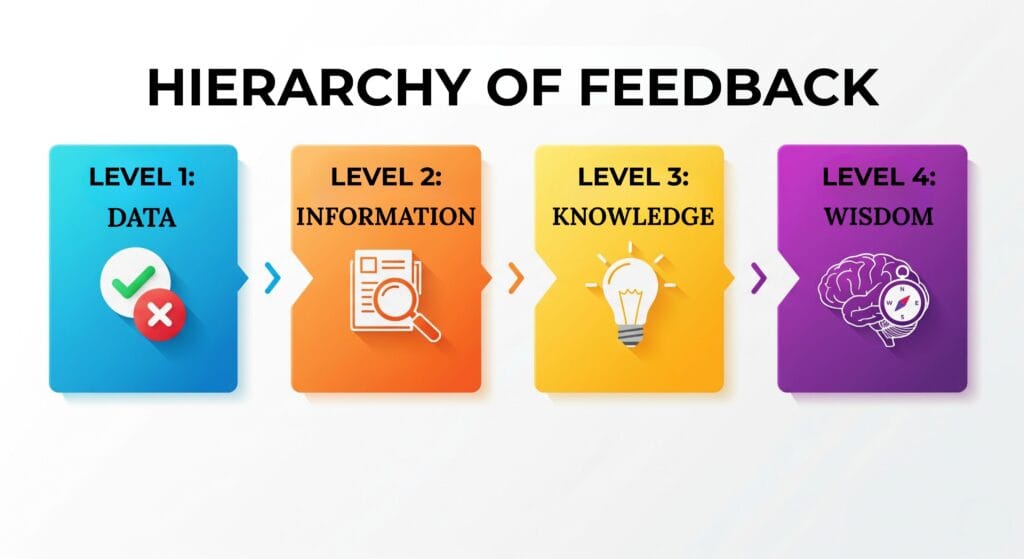
This constant cycle of practice -> feedback -> adjust -> repeat is the engine of skill acquisition. Without it, you’re just guessing.
Step 5: Embrace Plateaus and Ensure Consistency
Here’s a truth that discourages many aspiring masters: progress is never a straight line upwards. It comes in spurts and is inevitably followed by plateaus. A plateau is a period where you continue to practice, but your performance stops improving. It feels like you’ve hit a wall. It is the single most common point where people give up.
A fixed mindset interprets a plateau as a sign that you’ve reached the limit of your natural talent. It’s a signal to quit. A growth mindset, however, understands that plateaus are a normal, even necessary, part of the process. Think of it like a mountain climber ascending to a high altitude. They can’t just go straight to the top; they have to stop at base camps to acclimatize. A plateau is your brain’s base camp. It’s a period of consolidation where new skills are being automated and moved from conscious effort to subconscious competence. This frees up mental bandwidth for the next, more difficult climb.
But you can’t just wait it out. To master anything, you have to be strategic. Here’s how to break through:
- Change the Practice Routine: Your brain adapts to routines and can become complacent. Shock the system. Introduce new exercises or drills. Try practicing a skill in a different environment. This forces your brain to re-engage actively instead of running on autopilot.
- Increase the Difficulty Drastically (for a short time): Often, a plateau means you’ve become too comfortable. Push far beyond your current edge. If you’re practicing a song at 100bpm, try it at 130bpm. It will be sloppy, but when you return to 100bpm, it will feel significantly easier.
- Go Back to Basics: Sometimes a plateau is caused by a weakness in a fundamental micro-skill that you thought you had mastered. Go back to Step 2 and revisit the absolute basics. Perfecting a foundational element can unlock the next level of performance.
- Take a Strategic Break: Sometimes, the best way to break through a wall is to walk away from it for a short period. A day or two of rest can allow your brain to subconsciously process the problem, and you might return with a fresh perspective and renewed ability. This isn’t quitting; it’s tactical recovery.
Underpinning all of this is the superpower of consistency. A half-hour of focused, deliberate practice every day is infinitely more powerful than a heroic seven-hour session once a week. Mastery is a marathon, not a sprint. It’s about showing up even when you don’t feel like it, especially when you’re on a plateau. It’s about trusting the process. The best way to ensure this is to build a system. Schedule your practice sessions in your calendar as non-negotiable appointments. For those looking to build this kind of relentless routine, building powerful daily habits is the cornerstone of long-term success.
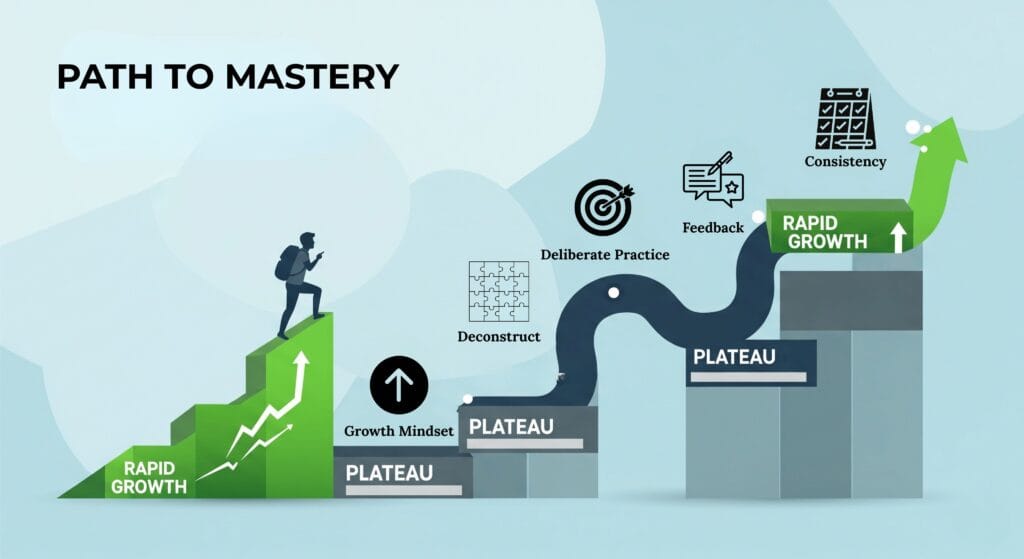
Advanced Concepts on the Path to Mastery
Once you have the 5-step framework running like an operating system in the background, you start to unlock more profound aspects of the journey. These aren’t steps so much as emergent rewards and realities of the process. They represent a deeper level of engagement with your chosen skill, transitioning it from a hobby into a part of your identity.
Finding Your Flow State
Have you ever been so completely absorbed in an activity that time itself seems to disappear? You’re not thinking, you’re just doing. Your performance feels effortless, fluid, and peak. Your sense of self dissolves into the action. That is the psychological state known as “flow,” a concept described by psychologist Mihaly Csikszentmihalyi after studying top performers in every field imaginable.
Flow is the ultimate reward of deliberate practice. It is the psychological payoff for all your hard work. Csikszentmihalyi found that flow tends to occur under specific conditions, which should sound very familiar:
- Clear Goals: You know exactly what you need to do from moment to moment. (Our “specific goals” from Step 3).
- Immediate Feedback: You can see the consequences of your actions right away. (Our “rapid feedback loops” from Step 4).
- A Balance Between Challenge and Skill: The task is difficult enough to require your full concentration but not so difficult that it causes anxiety. (Our “pushing beyond your comfort zone” from Step 3).
Do you see the connection? The entire framework of deliberate practice is designed to create the optimal conditions for flow.
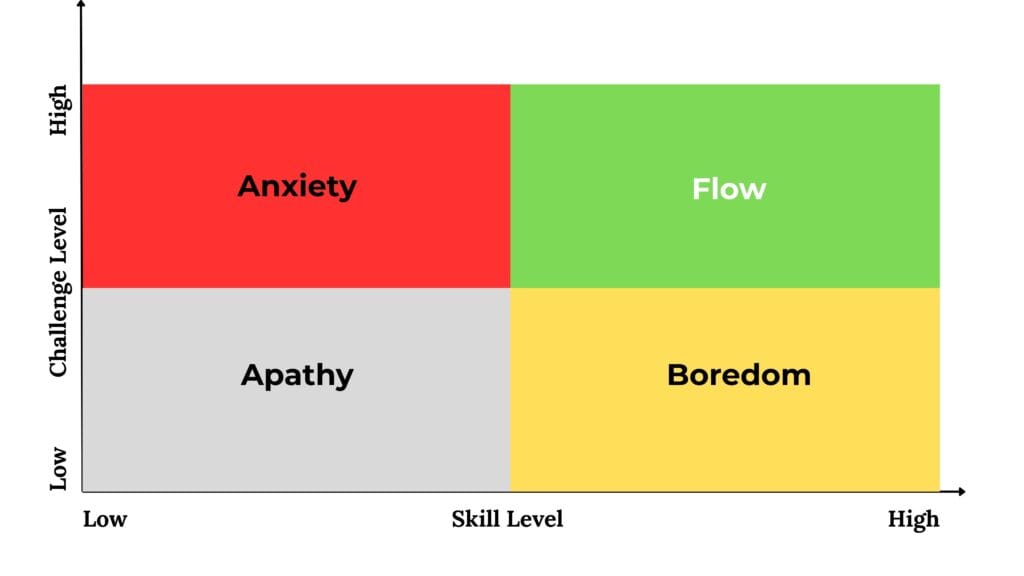
When you’re in a flow state, you are fully immersed, energized, and enjoying the process for its own sake. It’s the brain’s way of saying “YES! This is what we’re built for!” Achieving flow regularly is a powerful motivator. It turns practice from a chore into a deeply rewarding experience. It’s the feeling that makes you want to come back day after day. It is the profound joy of mastery in action.
The Power of Patience and the Long Game
Finally, let’s have a moment of real talk. In our culture of instant gratification, we want results now. We want the “30-Day Abs” and the “Learn a Language in a Week” hacks. But to truly master anything of value doesn’t work that way. The path to an expert level is long. It takes thousands of hours of high-quality, deliberate practice.
You must accept this from the outset. You have to fall in love with the long game. This requires a shift in identity. You are not just a person learning to play the piano. You are becoming a pianist. You are not just learning to code. You are becoming a programmer. When the skill becomes part of your identity, short-term frustrations lose their power. A pianist isn’t going to quit because they had a bad practice week; it’s just part of being a pianist.
This is the “craftsman mindset” versus the “hacker mindset.” The hacker wants the quickest trick to get an immediate result. The craftsman understands that the value is in the long, patient, and devoted process of honing their craft. They find satisfaction in the daily work, not just the final product.

Framing mastery as a long-term, rewarding journey rather than a short-term hack protects you from the inevitable frustrations. When you see your skill as a lifelong companion and a path of continuous growth, you’re not discouraged by a bad week or a slow month. It’s all just part of the beautiful, winding road. Patience isn’t just a virtue on this path; it’s a strategy for ultimate success.
You Are the Architect of Your Potential
So, we return to where we started: that feeling of frustration when facing a new skill, staring at that dusty guitar. But now, it should look different. The wall of “I’m not talented” has been dismantled, brick by brick, and replaced with a clear, structured blueprint. Mastery is not an accident of birth. It is a choice. It is a process. It is a system you can execute.
Let’s quickly recap the framework, your system to master anything:
- Cultivate a Growth Mindset: Your foundational belief. See your potential as limitless and embrace the process of becoming better.
- Deconstruct the Skill: Make the impossible possible by breaking it into small, manageable micro-skills.
- Engage in Deliberate Practice: Turn your time into progress with focused, goal-oriented practice at the edge of your abilities.
- Create Rapid Feedback Loops: Practice with your eyes open, using feedback to guide your every move.
- Embrace Plateaus & Ensure Consistency: Master the art of navigating stalls and showing up day after day, because consistency is the engine of long-term success.
You are the architect of your own potential. This framework is your set of tools. The world is full of fascinating skills waiting to be learned, from art and music to science and technology. There is no secret. There is only this process. With this framework, you can master anything. The only question left is: What will you build ?
What is the one skill you are committed to mastering? Share it in the comments below and tell us which step you’ll start with first!