
The Panic of the Empty Cart (And the Joy of Getting It Right)
Learning how to give meaningful gifts can feel like a daunting task, especially when you’re staring at a blinking cursor on an empty checkout screen. We’ve all been there. That blinking cursor on an empty checkout screen. A birthday, an anniversary, or a holiday is staring us down, and the panic is setting in. We scroll endlessly, looking for something.
And then, we give up. We buy the gift card.
Let’s be real—it’s not the worst thing in the world. But it feels like a transaction. It’s an admission of, “I had to get you something, but I had no idea what.” It’s a checklist item.
Now, think about the opposite. Remember a time you received a gift that just… got you? It might not have been expensive. Maybe it was a specific book, a framed photo, or just a perfectly-timed offer to help. That feeling? That’s the feeling of being truly seen.
The truth is, giving a gift like that brings even more joy.
This is the central challenge of our busy lives: We want to give meaningful gifts, but we’re overwhelmed by the process. We’re here to change that. This guide is built on a simple premise: Gifting isn’t a financial transaction; it’s a practice of mindfulness, observation, and connection. We’re going to show you how to give meaningful gifts with a practical framework that moves us beyond the gift card for good.
The Philosophy: What Is a “Genuinely Meaningful Gift?”
First, let’s redefine “meaningful.” A high price tag doesn’t equal high thoughtfulness. We all know that. A genuinely meaningful gift is simply a physical or experiential symbol that says, “I pay attention to you.”
It’s not about mind-reading. Understanding how to give meaningful gifts is built on a practice of mindfulness—the simple act of being present and aware.
When we break it down, a truly thoughtful gift has three parts:
- It Demonstrates You Listen: The gift is directly connected to a past conversation, a casual complaint (“I’m always so cold in the office”), a passing comment (“I’ve always wanted to learn…”), or a long-held dream.
- It Prioritizes Their “Need” Over Your “Idea”: This is a big one. We often buy what we would want. But their “need” might be practical (a solution to a problem), emotional (a dose of comfort), or intellectual (a new experience).
- It Carries a Specific Message: The gift isn’t just an object; it’s a message. That message is, “I see you,” “I appreciate you,” or “I was thinking of you when I saw this.”
The core of our philosophy is the unity among observation, intention, and action. To better visualize how these three moments must come together to create that ‘perfect’ feeling, we highly recommend watching this insightful TEDx talk.
The best part? This is a skill anyone can learn.
This post contains affiliate links. That means if you click a product link and make a purchase, we may earn a small commission—at no extra cost to you. As an Amazon Associate, we earn from qualifying purchases. It’s one of the ways we keep this website running and continue bringing you helpful content. So, thank you—seriously, your support means the world to us!
The Framework: How to Give Meaningful Gifts in 6 Practical Steps
Alright, let’s get to the good stuff. This is the actionable, repeatable process for how to find the perfect gift for literally anyone in your life.
1. Become a “Gift Detective” All Year
The best gift ideas don’t pop up two days before a birthday. They are collected, piece by piece, over time.
This is the single most important habit you can build.
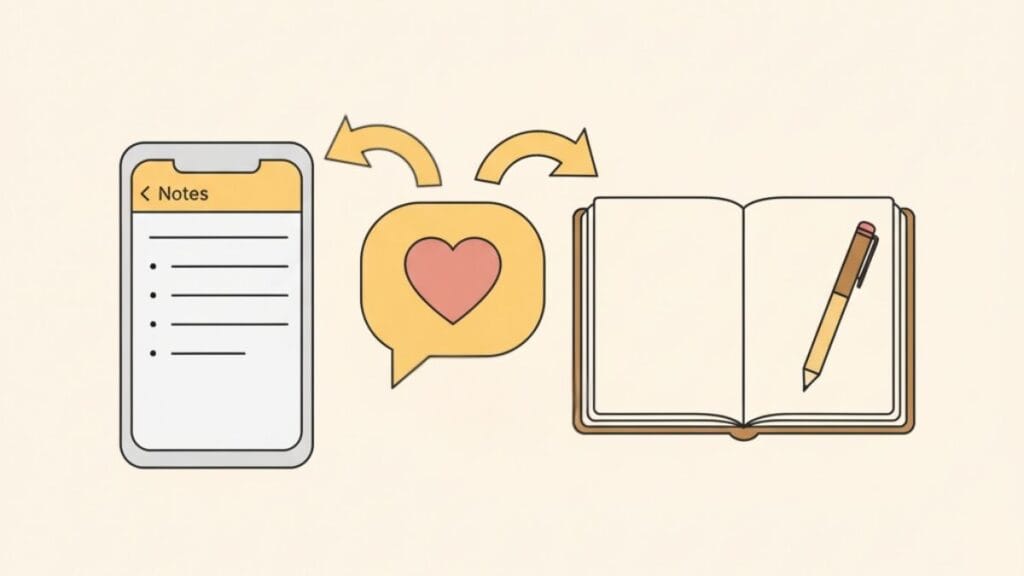
The solution is simple: Create a private, running note in your phone’s app or a small digital notebook for the key people in your life. Call it “Gift Ideas” or “Treasure Map”—whatever works.
Your Action Step: Open your phone right now. Create a new note. List the 5-10 most important people you give gifts to.
From this moment on, when you’re with them, listen.
- When your friend says, “Ugh, my phone battery is always dying by 3 PM,” write it down. (Future gift: portable power bank).
- When your partner says, “I wish we had more old photos around,” write it down. (Future gift: framed print of a favorite memory).
- When your co-worker mentions, “I’m so bored of my lunches,” write it down. (Future gift: a bento box, a “quick lunch” cookbook).
These casual complaints and “I wish…” statements are gold. They are explicit instructions. Your note app becomes a treasure map to the perfect, meaningful gift, and it costs you nothing but a moment of attention.
2. Brainstorm Beyond “Things”: The Four Categories of Meaning
We get stuck. We think a gift must be a physical object that comes in a box. If you are struggling with how to give meaningful gifts, this is often where we go wrong! It limits our options and forces us into buying “stuff” for people who might not want more stuff.
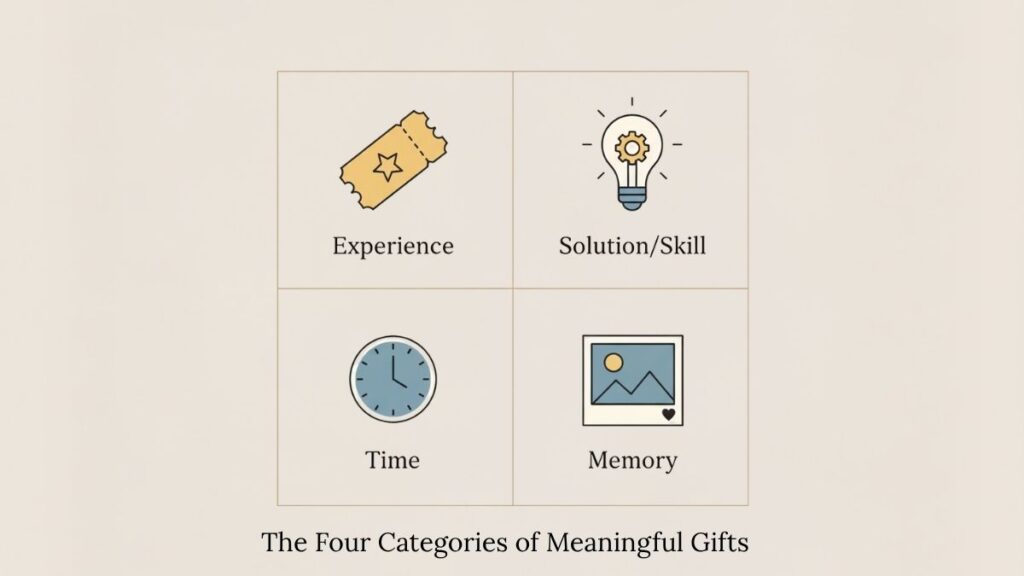
Let’s expand our definition of a gift. Truly meaningful gift ideas fall into four categories:
- Gifts of Experience: These create memories. This is where you shine. Think tickets to a concert or play, a local cooking class for a cuisine they love, or planning a small weekend getaway for them. Experiences often mean far more than objects.
- Gifts of Solution & Skill: This is about solving a problem or enabling a hobby. Does your dad complain about his old, crackling radio? Does your friend want to learn a new language? This category includes everything from a subscription to a platform like Magzter for a magazine lover, to a Click & Grow smart garden for the apartment-dweller who wants a garden, to a great noise-cancelling headphones for a commuter or someone in a loud office.
- Gifts of Time: For many people, this is the most valuable and meaningful gift of all. Offer a “coupon” for 3 hours of uninterrupted “you” time (while you babysit). Offer a weekend to help them paint that room they’ve been dreading. Offer your skills to edit their resume or design an invitation.
- Gifts of Memory: These gifts are pure connection. A beautifully framed photo from a shared trip, a custom-made playlist of songs from your college days (on a USB drive or as a shared Spotify list), or taking the time to digitize an old home movie. These hit right in the heart.
3. Reframe the “Person Who Has Everything”
Ah, the “person who has everything.” We all know one. This is the person who makes us want to just give up and buy that gift card.
Here’s the reframe: They do not have everything.
They lack time. They lack specific, curated memories. They lack solutions to tiny, micro-problems they might not even know can be solved.
This person is the perfect candidate for the Four Categories we just discussed. They are, in fact, the easiest person to buy for, because you can immediately eliminate “things.”
- They don’t need another sweater. They will value a Gift of Time (your undivided attention for a full afternoon of their favorite activity).
- They don’t need another gadget. They will value a Gift of Experience (a class on a niche topic they’re curious about, like pottery or coding).
The keyword to search for gift ideas for people who have everything is consumable. This can mean food (a high-end bottle of olive oil, a local honey-tasting kit) or an experience (a ticket, a class). It’s a gift that can be used up and enjoyed, leaving only a great memory behind—not more clutter.
Many of the ideas in our Thoughtful Travel & Style section can be a great place to find inspiration for these niche experiences.
4. Ask Connection-Building Questions (Not “What Do You Want?”)
Asking “What do you want for your birthday?” is a chore. It puts all the pressure and burden of idea-generation on the recipient. It’s not a gift; it’s an assignment.
Instead, be a detective (from Step 1). A key part of learning how to give meaningful gifts is asking questions in casual conversation—weeks or months in advance—that build connection and secretly gather gift intelligence.
Try these:
- “What’s a small, simple thing that’s bringing you joy lately?”
- “If you had a completely free Saturday with no obligations, how would you love to spend it?”
- “What’s a small, annoying problem you’ve been trying to solve recently?”
- “Is there anything you’re curious about or have been thinking about learning?”
Their answers are your new gift list.
5. The “Why” Is Part of the Gift: Master the Note
This step is critical. A meaningful gift can fail if the recipient doesn’t understand the thought behind it.
You bought them a high-quality, weighted-blanket. They open it and think, “A blanket? Okay, thanks.”
But what if it’s paired with a simple, handwritten note that says:
“I remembered you mentioned you’ve been having trouble sleeping and feeling anxious. I read that these weighted blankets can feel like a warm, comforting hug. I hope this helps you get the deep, restful sleep you deserve.”
See the difference? You just transformed a blanket from an object into a message: “I listen to you, and I care about your well-being.”
The note connects the dots. Here’s a simple 3-part formula:
- The Observation: “I remembered you mentioned…”
- The Connection: “It made me think of…” or “I wanted you to feel…”
- The Wish: “I hope this helps you…” or “I hope this brings you…”

6. Present It with Presence
The final step is the delivery. How you give the gift matters. Don’t just toss it at them while you’re both distracted by your phones.
Make the act of giving a small moment of connection. Put your phone away. Make eye contact. Genuinely watch them open it. Share the “why” from your note out loud.
Your presence is the final, essential ingredient. The focus should be on their reaction and their moment, not your own anxiety about whether they’ll like it. If you’ve followed the steps above, you can be confident.
Gifting as an Act of Joy, Not an Obligation
The bottom line? How to give meaningful gifts is a skill, not an innate talent. It’s a practice that gets easier, more natural, and more joyful the more you do it.
The goal is not to spend more money. The goal is to give more attention.
By shifting our mindset from “obligation” to “observation,” we can turn a stressful task into one of the most powerful ways to strengthen our relationships. This gift giving philosophy is a core part of the ideas we explore in our Smarter Living pillar.
This year, let’s skip the panic of the empty cart. We have the tools. Let’s go make someone feel truly seen.
What’s the most thoughtful gift you’ve ever received, and why did it mean so much to you? Share your stories in the comments below!