
Why Mindless Repetition Isn’t a Path to Mastery
Let’s be real for a moment. We’ve all been there. You pick up a guitar, determined to become the next rock legend. You practice the same three chords for hours a week, for months, even years. But somehow, you never seem to graduate beyond a slightly clumsy campfire singalong. Or maybe it’s a new language, where you’ve been using the same app daily, but you still can’t hold a basic conversation. It’s frustrating, right? You’re putting in the hours, but the needle just isn’t moving.
This common struggle is often tied to a popular myth: the “10,000-Hour Rule.” The idea, popularized by Malcolm Gladwell, is that 10,000 hours of practice can make you an expert in anything. But here’s the kicker that often gets missed: the problem isn’t the number of hours. It’s the type of effort within those hours. Simply repeating an action doesn’t guarantee improvement. This is the huge difference between aimless repetition and a powerful, focused approach called deliberate practice.
Pioneered by psychologist Anders Ericsson, whose research formed the basis of the 10,000-hour concept, the core idea is a game-changer: the quality of your practice trumps the quantity every single time. It’s the secret ingredient that separates the dedicated amateurs from the awe-inspiring virtuosos in every field imaginable. In this guide, we’re going to break down the exact 5-step framework of deliberate practice that top performers use to learn faster, smash through plateaus, and achieve true mastery.
What is Deliberate Practice?
So, what exactly is this magic bullet? Simply put, deliberate practice is a highly structured and purposeful form of training designed with one goal: to improve performance. It’s not just playing the piano; it’s systematically identifying, isolating, and correcting the specific three-note sequence you keep fumbling. It’s not just going for a jog; it’s running specific intervals to improve your cardiovascular threshold.
To truly grasp its power, it’s crucial to understand what it’s not. To truly grasp its power, it’s crucial to understand the clear distinction between deliberate practice and other activities:
- It’s not work. When you’re at your job, you’re usually executing skills you’ve already mastered. The primary goal is to be productive and get the job done, not to systematically improve a weakness.
- It’s not play. When you play a game of pickup basketball or jam on the guitar with friends, your goal is enjoyment. It’s unstructured and fun, but it’s not designed for systematic, targeted improvement.
Deliberate practice is different. It’s not always fun. In fact, it’s often mentally taxing and requires intense effort. Its defining characteristics are that it is:
- Purposeful: It has a specific, well-defined goal.
- Focused: It demands your complete, undivided attention. No multitasking allowed.
- Feedback-Driven: It involves constantly seeking and integrating feedback to correct errors.
- Challenging: It requires you to step outside your comfort zone and tackle things just beyond your current abilities.
This isn’t about mindlessly logging time. It’s about making every single moment of that time count toward tangible improvement.
To see how this process physically works inside your brain, the excellent animation below from TED-Ed breaks down the science of how effective practice builds skill.
The 5-Step Framework for Deliberate Practice
Alright, let’s get into the how-to. This is the core of the entire process. We’ve broken down the science of deliberate practice into five clear, actionable steps you can apply to literally any skill, from coding to cooking to public speaking.
Step 1: Set a Specific, Well-Defined Goal
First things first, you have to know exactly what you’re trying to achieve. Vague goals like “get better at writing” are the enemies of progress. Why? Because you can’t measure them! Effective learning requires a laser focus on a tiny, specific component of the larger skill.
A deliberate practice goal isn’t “improve my tennis game.” It’s “increase my first-serve accuracy into the deuce court by 10% over the next two weeks.” See the difference? It’s specific, measurable, and targeted. This approach involves creating a hierarchy of goals. Your master goal might be “become a great public speaker,” but that breaks down into sub-skills like storytelling, vocal variety, and body language. Each of those then breaks down into a micro-goal for a single practice session.
Actionable Examples:
- For a salesperson: The sub-skill is handling objections. The micro-goal for today’s practice is, “Successfully counter the ‘it’s too expensive’ objection using the ‘value-framing’ technique in three consecutive role-play scenarios.”
- For a programmer: The sub-skill is writing efficient code. The micro-goal is, “Refactor the user login function to reduce its database query time by 150ms.”
- For an artist: The sub-skill is mastering light. The micro-goal is, “Use cross-hatching to accurately render the shadow cast by a sphere under a single, direct light source.”
Break your big dream into these tiny, bite-sized missions. This is the first and most crucial step in effective learning.
Step 2: Design the Practice Activity and Stay Intensely Focused
Once you have your mini-mission, you need to design an exercise that targets it directly and exclusively. This means isolating the skill component. If your goal is serve accuracy, your practice isn’t playing a full match; it’s hitting a bucket of balls aimed at a specific target in the service box. If your goal is mastering a guitar solo, it’s not playing the whole song; it’s looping the two most difficult bars at 50% speed until they are flawless.
Just as important is your mental state. Deliberate practice requires deep, single-minded focus. Not even kidding, this is non-negotiable. Put your phone in another room, close those extra browser tabs, and dedicate a block of time solely to this task. Concentration is a finite resource, so working in short, intense bursts of 60 to 90 minutes, followed by a period of rest, is far more effective than hours of distracted, low-quality practice. This aligns perfectly with powerful systems for productivity and peace of mind that prioritize deep work over shallow, multitasking efforts.

Step 3: Implement an Immediate and Informative Feedback Loop
This might be the most critical, and most overlooked, step of them all. Seriously though, practicing without feedback is like trying to navigate a maze with a blindfold on. You’re moving, but you have no idea if you’re getting closer to the exit or just running into the same wall over and over. A tight feedback loop is essential for effective learning.
Good feedback has to be three things: immediate, specific, and actionable. “Good job!” is useless. “Your intonation was perfect in the first verse, but you went slightly flat on the high E in the chorus” is gold.
There are two main types of feedback:
- Internal Feedback: This is your own ability to self-monitor. As you get better, you’ll start to notice your own mistakes in real-time. That feeling when a musician hits a sour note or a writer spots a clunky sentence? That’s internal feedback at work.
- External Feedback: This comes from an outside source. It could be a coach pointing out a flaw in your golf swing, a mentor reviewing your business plan, or even software that provides analytics on your performance.
How to get it:
- Record yourself! Use your phone to film your presentation, your tennis swing, or you playing an instrument. The camera doesn’t lie and provides instant, objective feedback.
- Use technology as a coach. Use a software that provides analytics, like a chess engine that analyzes your moves, a language app that rates your pronunciation, or a golf simulator that tracks your swing path.
- Seek expert review. The fastest way to improve is to get feedback from someone who is already an expert. Hire a coach, ask a more experienced colleague for a code review, or join a workshop.
Step 4: Constantly Push Beyond Your Comfort Zone
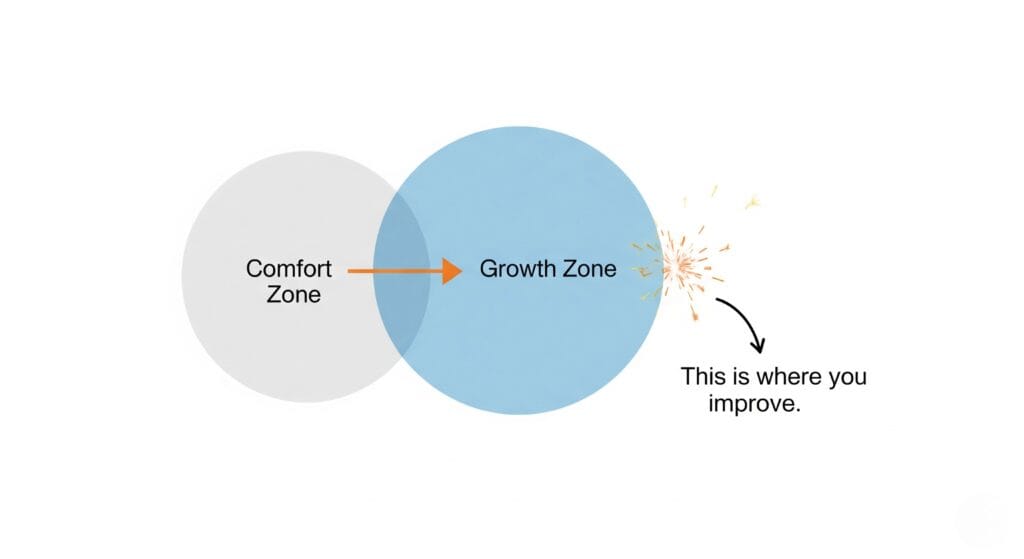
Here’s a simple truth: if your practice feels easy, you’re not getting better. You’re just reinforcing what you already know. Growth only happens at the edge of your abilities, in that slightly uncomfortable space where you’re stretching yourself and making mistakes. Psychologists call this the “zone of proximal development,” but we can call it the “Goldilocks Zone“—not too easy, not too hard, but just challenging enough to require intense focus.
Think of it like lifting weights. To build muscle, you have to lift a weight that is challenging. Once it becomes easy, you increase the weight. Deliberate practice is the mental equivalent. This can be emotionally taxing; it’s frustrating to fail. But you must reframe these mistakes not as failures, but as data. Each error provides valuable information on what you need to adjust. Embracing this discomfort is a cornerstone of developing a strategic mind to overcome challenges.
Step 5: Reflect, Refine, and Repeat
Finally, deliberate practice is a cycle, not a straight line. After each focused session, take five minutes to stop and reflect. What did the feedback tell you? What mistakes did you make, and what was the root cause? What worked well that you should continue doing?
Based on this reflection, you refine your approach for the next session. Maybe you need to break the goal down even further. Maybe you need to slow down the tempo. Maybe you need to seek a different kind of feedback. Keeping a simple practice journal is incredibly powerful here. A quick entry can solidify your learning and provide a clear plan.
Sample Journal Entry:
- Date: Sept 6, 2025
- Session Goal: Play the C-minor scale on the piano, two octaves, at 100 bpm with zero mistakes.
- What I Did: Practiced for 45 minutes, starting at 60 bpm and slowly increasing.
- Feedback/Observations: Kept fumbling the fingering on the descending run around F. My wrist is too stiff.
- Key Takeaway: The issue isn’t speed, it’s my hand position on the way down.
- Next Session’s Focus: Practice only the descending C-minor scale at a very slow speed, focusing on keeping my wrist relaxed.
This iterative process of practice -> feedback -> reflection -> refinement is what creates a powerful compounding effect, leading to dramatic improvements over time.
Putting It All Together: Two Examples in Action
Let’s make this concrete. Here’s how deliberate practice looks for both a hobby and a professional skill.
Example 1: Baking the Perfect Sourdough Loaf
- Step 1: Set a Specific Goal. Your goal isn’t “bake good bread.” It’s “Consistently get a good ‘ear’ (the raised flap of crust) on my sourdough loaf, which shows proper oven spring.”
- Step 2: Design Focused Practice. You dedicate a 60-minute session not to the whole baking process, but only to practicing different dough scoring techniques on dummy dough balls. You watch videos of experts and imitate their exact motions.
- Step 3: Get Immediate Feedback. After baking, you take a picture of your loaf’s crust. You compare it side-by-side with photos of perfect loaves online or in a baking book. You see your score wasn’t deep enough.
- Step 4: Push the Comfort Zone. In your next bake, you try a more complex scoring pattern you saw an expert use, even though it feels awkward and difficult.
- Step 5: Reflect, Refine, Repeat. You note in your journal that a deeper score at a 30-degree angle gave you a much better ear. That becomes your new baseline technique, and for the next session, you set a new goal: “Master the cross-hatch scoring pattern.”
Example 2: A Software Developer Writing Cleaner Code
- Step 1 (Goal): “Master writing reusable React components by separating logic from presentation.”
- Step 2 (Focus): Take an existing, messy component and spend a 90-minute focused block refactoring it. The entire focus is on moving all state management into custom hooks.
- Step 3 (Feedback): First, a code linter provides immediate, automated feedback. Then, a pull request is submitted for review by a senior developer, who provides high-level structural feedback.
- Step 4 (Comfort Zone): Instead of using a familiar pattern, the developer forces themself to implement a more advanced concept, like the Context API, which they’ve read about but never used.
- Step 5 (Reflect & Repeat): The senior dev’s feedback highlights an issue with unnecessary re-renders. The journal entry notes this, and the next session’s goal is: “Refactor the component using the useMemo hook to prevent performance bottlenecks.”
You Are the Architect of Your Own Skills
The idea of “natural talent” is one of the most persistent myths out there. While genetics might give some a slight head start, research shows that expert performance is overwhelmingly the product of intelligent, sustained, and focused effort. It’s built, not born.
By moving away from mindless repetition and embracing the five steps of deliberate practice—setting specific goals, maintaining intense focus, using feedback, pushing your limits, and constantly refining your approach—you become the architect of your own abilities. You hold the blueprint for learning faster and achieving mastery in anything you set your mind to.
What skill are you currently working on? Share one specific goal you can set for your next deliberate practice session in the comments below!