The Invisible Glitches in Our Thinking
Have you ever bought something on a whim, absolutely convinced it was the best thing since sliced bread, only to have it gather dust a week later? Yeah, us too. Or maybe you’ve held onto a belief with all your might, only to find out later the facts just didn’t back it up. It’s not a great feeling. But what if we told you this isn’t a personal failing? Seriously though, it’s just your brain doing what it’s designed to do: take shortcuts.
Our brains are incredibly powerful, but to navigate a complex world, they create mental shortcuts. Most of the time, these work beautifully. But sometimes, they lead to predictable errors in judgment. These glitches in our thinking are known as cognitive biases. They’re universal features of the human mind that create “thinking traps,” subtly influencing our decision-making without us even noticing.
This guide promises to shine a light on five of the most common cognitive biases. Understanding these mental traps is the first step toward improving your critical thinking and making clearer, better choices. Think of this as the start of building a powerful toolkit of mental models to navigate the world with greater awareness. Let’s dive in.
1. Confirmation Bias: The Echo Chamber in Your Head
So, what’s the number one culprit? Confirmation Bias. This is our natural tendency to seek out, interpret, and remember information that confirms what we already believe. At the same time, we conveniently ignore or dismiss anything that challenges our views. It’s like living in a personalized echo chamber where every voice is just a reflection of our own. Not even kidding, it’s that pervasive.
A classic example is how we consume news. When we’re researching a topic we feel strongly about, we almost automatically click on headlines from sources we know will agree with us. We get a little hit of satisfaction, a feeling of being “right.” The same thing happens when you want to buy a new gadget. You’ve set your heart on a specific model, so what do you search for? “Awesome reviews for [phone name],” not “problems with [phone name].” This isn’t about being dishonest; it’s about the brain’s desire for consistency. Evidence suggests this is often reinforced by a similar mental shortcut known as the Halo Effect, where one positive trait makes us see everything else in a positive light.

How to Overcome It: The “Steel Man” Technique
To break out of the echo chamber, you have to intentionally seek out dissenting opinions. Try the “Steel Man” technique. Instead of creating a weak “straw man” version of the opposing argument to easily knock down, do the opposite. Actively find the strongest, most intelligent argument against your own position. Try to argue for the other side so persuasively that someone else would be convinced. This exercise in critical thinking forces your brain to grapple with conflicting data, leading to a more balanced view.
2. Anchoring Bias: The First Piece of Information
Ever walked into a store and seen a jacket marked at $400, then noticed it was on sale for $250? You immediately think, “Wow, what a deal!” That’s Anchoring Bias in action. Our brains tend to rely too heavily on the first piece of information offered (the “anchor”) when making decisions.
The classic example is negotiation. Let’s say you’re looking at a used car with a sticker price of $20,000. That number is now the anchor. Even if you’re a skilled negotiator and talk the seller down to $17,000, your perception of getting a “good deal” is entirely shaped by that initial, potentially inflated, price. Without that anchor, would you have valued the car at $17,000 on your own? Maybe, maybe not. This bias affects everything from salary negotiations to how much we’re willing to pay for our morning coffee.

How to Overcome It: Reset Your Anchor
The key to overcoming this thinking trap is to be prepared. Before entering any negotiation or making a major purchase, do your own independent research. Find out the market value of the car, the average salary for the position, or the typical price of similar items. By establishing your own anchor based on objective data, you’re less likely to be swayed by the first number someone throws at you. This conscious step is a cornerstone of effective decision-making. You might even want to keep a decision-making journal to track your research and thoughts.
3. Availability Heuristic: If You Can Think of It, It Must Be Important
Which is more deadly: a shark attack or a falling coconut? If you said shark attack, you’re not alone, but you’d be wrong. We hear about shark attacks because they’re dramatic, terrifying, and make for sensational news. Falling coconuts? Not so much. This is the Availability Heuristic at play. We overestimate the importance and likelihood of things that are most recent, vivid, and easily recalled in our minds.
This bias messes with our perception of risk and is a powerful force in our daily decision-making. Because plane crashes are extensively covered in the media, many people have a greater fear of flying than driving, even though statistics show driving is far riskier. The vivid images of a crash are more “available” to our brains than the mundane reality of daily car accidents. This is one of those cognitive biases that really preys on our imagination.

How to Overcome It: Think in Probabilities, Not Pictures
When you feel a decision is being swayed by a vivid story or a dramatic event, pause. Consciously ask yourself, “What are the actual statistics here?” Look for real-world data instead of relying on mental images that pop into your head. It takes a little more effort, but shifting from anecdotal evidence to probabilities can save you from making fear-based choices and is a crucial part of self improvement.
4. The Sunk Cost Fallacy: Trapped by Past Investments
Have you ever sat through a truly awful movie just because you already paid for the ticket? Or kept pouring money into a failing business project because you’d already invested so much? Welcome to the Sunk Cost Fallacy. This is our tendency to continue an endeavor because we’ve already invested time, money, or effort—the “sunk costs”—even when all current evidence suggests it’s time to stop.
We hate to feel like we’ve wasted our resources. Letting go means admitting we made a bad decision in the past, and that can be painful. This trap isn’t about logic; it’s about emotion. The force behind this trap is often the mental discomfort of admitting a past decision was wrong, a feeling closely related to Cognitive Dissonance: The Battle in Your Mind. We stick with the bad investment or the terrible movie to justify our initial choice, often making the situation worse.

How to Overcome It: The “Fresh Start” Question
To escape this trap, you need to reframe the decision. Ask yourself this powerful question: “Knowing what I know now, if I were starting from scratch today, would I make this same choice?” If the answer is no, it’s time to cut your losses. The past investment is gone, regardless of what you do next. Your future decision-making should be based only on the potential future outcomes, not on past mistakes. Consider getting some critical thinking books to explore this and other fallacies further.
5. The Dunning-Kruger Effect: The Confidence of Incompetence
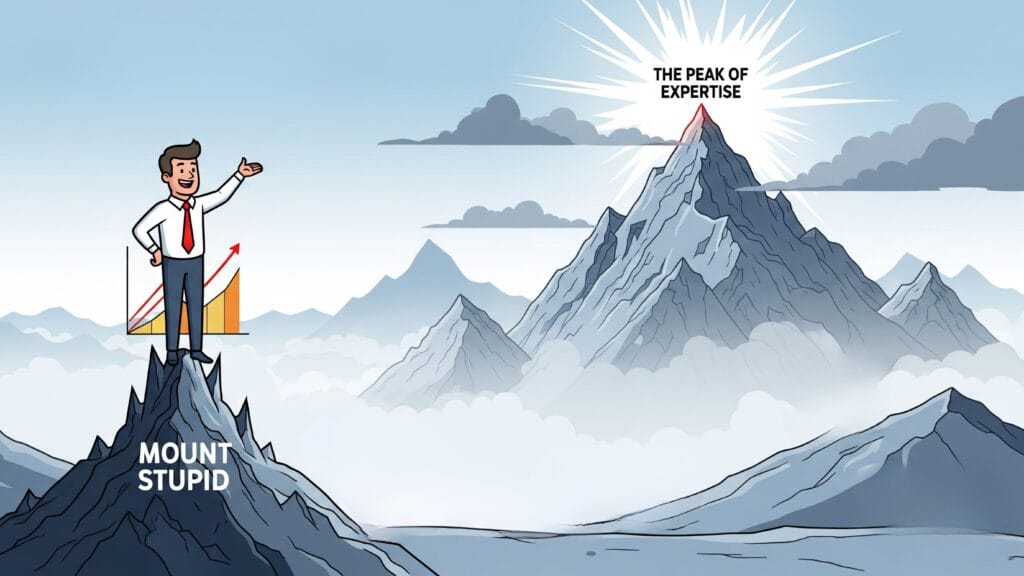
The Dunning-Kruger Effect is one of the most fascinating cognitive biases. In short, it’s a situation where people with low ability at a task overestimate their own ability. They are, in a sense, too incompetent to even recognize their own incompetence. We’ve all seen it: the person who just started learning about investing and suddenly thinks they’re the next Warren Buffett, or the amateur singer who’s utterly convinced they’re destined for stardom.
Conversely, true experts often underestimate their competence, because they’re so aware of how much there is to know. This phenomenon highlights a fundamental truth about learning and expertise: the more you know, the more you realize you don’t know. It’s a humbling part of the journey toward genuine skill and is a critical concept in self improvement.
How to Overcome It: Embrace a “Circle of Competence”
The antidote is intellectual humility. Be brutally honest about what you know and, more importantly, what you don’t. Define your “circle of competence” and be wary of stepping outside it to offer expert opinions. Always assume there is more to learn. Actively seek constructive feedback from people who are genuine experts in the field. A continuous desire to learn and improve is the only way to ensure your confidence is aligned with your actual ability. Feel free to browse our Guides for more topics on personal growth or Contact Us with your questions.
Awareness is the First Step
From the echo chamber of Confirmation Bias to the false confidence of the Dunning-Kruger Effect, these thinking traps are part of what makes us human. These five cognitive biases are working in the background of our minds all the time. The goal isn’t to eliminate them completely—that’s likely impossible.
The real power comes from awareness. Just by knowing these biases exist, you can start to spot them in your own thinking and in the world around you. This awareness is the first, most crucial step toward achieving mental clarity. It empowers you to pause, question your assumptions, and ultimately improve your decision-making. So, the next time you have a gut feeling, you can ask yourself: is this true insight, or just a glitch in the system? You can learn more About our mission to explore these topics on our site.
To take a deeper dive into even more of these mental traps, the comprehensive video below is an excellent resource:
Which of these thinking traps do you notice most in your own life or in the world around you? Share your experience in the comments below!